I’d love to help him add to his list by giving him links to all the Catholic teachers on Twitter. If you’re a Catholic teacher and you Tweet, leave a comment below with your Twitter name and I’ll send the list to Fr. Roderick.
You can find me on Twitter at http://twitter.com/nsenger. If you’re not on Twitter, and you don’t know what all the fuss is about, check out the video at the end of this article.
P.S. I was a bit chagrined to find that Fr. Roderick and I are using the same WordPress theme, but what can I say, I guess great minds think alike!
Teachers provide instruction in the original sense of the term, that is, they make a substantial contribution to building the personality; they educate in the sense of the ancient Socratic image, helping students to discover and to make use of the skills and gifts of each one…
You have been called to teach. This is a vocation, a Christian vocation…There, at your teacher’s chair and desk, God has called you by name to an indispensable service to the truth.
Wesley Fryer has published a presentation he made on Copyright for Educators. Wesley was named an Apple Distinguished Educator in 2005 and in this slide show he gives teachers important information about the impact of copyright law on the classroom.
The NCEA, in conjunction with Pflaum Publishing Group, has released two game modules for the Classroom Jeopardy System that are designed to help students prepare for the ACRE, the Assessment of Catechesis/Religions Education. The ACRE is a faith assessment tool used by many schools across the United States to strengthen their catechetical programs. These new game modules are intended to “promote internalizing faith facts.”
The modules themselves are not expensive–about $30 each. One cartridge is for Grade 5, the other is for Grades 8-9. However, to use the cartridges, a school must purchase the Classroom Jeopardy System, which was selling for $419 on Amazon.com as of this writing. The system includes wireless player remotes, a scoreboard, and hardware for using the cartridges.
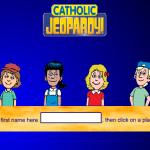
If the Jeopardy system is beyond your school’s budget, you might have your students try Pflaum’s online Catholic Jeopardy. The questions are generally well written, and probably most appropriate for students in grades 3-8.
Catholic Jeopardy!
One question bothered me, though: “People often hold hands during this prayer, signifying their unity as Children of God.” The answer is The Lord’s Prayer, but since this isn’t an official part of the liturgical rubrics, I don’t think it belongs in a Catholic assessment tool. Not a major point, I admit, but a minor irritation.
If you browsed the bookshelves of a Catholic teacher, what titles would you expect to find? Today marks the beginning of an ongoing series about the books that should be on the shelves of every Catholic teacher. The list is, of course, subjective, and we could debate about whether every title is “essential,” but I think that overall you’ll find the titles in this series useful on your journey as a Catholic educator.
Book 1: The Bible
This may seem too obvious to list, but I want to begin here because even though I’m reasonably certain that every Catholic educator owns a Bible, it’s good to be reminded to take it out and read it. We’re on the front lines of faith formation, and we owe it to our students and our Lord to know the Bible more intimately than any other book we’ve ever read. I still have a long way to go in that department. I’ve been teaching Les Misérables for almost thirteen years, and I have to admit that I probably know Hugo’s novel better than I know the Bible. Granted, the Bible is much more difficult to understand, but that’s all the more reason to read it habitually.
How to Read the Bible
There are many ways to approach reading the Bible, but I want to highlight an approach called lectio divina. Lectio divina is one of those ancient-but-ever-new gifts of the Church, and rather than summarize it here, I will instead direct you to this excellent article by Benedictine monk Fr. Luke Dysinger. I had the privilege of meeting Fr. Luke when I stayed a week at St. Andrew’s Abbey in California, and his article will give you a solid introduction to the practice of praying with scripture.
Whether or not lectio is for you, as a Catholic educator you must be a regular reader of God’s word. Take these epigrams as motivation:
Ignorance of scripture is ignorance of Christ.
Bibles that are falling apart usually belong to people who aren’t.
You’re the only Bible some people will ever read.
The Question of Translation
Often people ask which translation of the Bible they should use. James Akin has a fairly thorough discussion of how to choose a Bible and that would be as good a place as any to begin. But I like the practical advice I once heard when someone asked which translation was best: “The one you read.” Here are two of the most common Catholic translations:
The New American Bible – This is, of course, the translation used for liturgies in the United States, and for that reason alone it would make a very good Bible for personal use. On the other hand, a different translation can sometimes be helpful in overcoming the “I’ve heard this story before” syndrome.
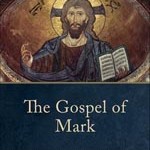
I’d like to mention one more Bible resource that I discovered about a month ago. Baker Academic is beginning to produce an ambitious series of books called the Catholic Commentary on Scripture. Only two volumes have been produced so far, The Gospel of Mark and First and Second Timothy, Titus. I have both volumes, and I’m currently using The Gospel of Mark commentary in my daily lectio. I can’t say enough about how helpful this commentary is. I highly recommend the series, and I will be purchasing every volume as they are made available.
Conclusion
I hope I don’t have to convince anyone that every Catholic teacher needs the Bible on their bookshelf. More importantly, however, is that every Catholic teacher needs the Bible off their bookshelf. It should be on your nightstand, or at the breakfast table, or on an end table next to your favorite reading chair. Keep a copy in your car, or your purse or your briefcase. How we can speak about God to our students, if we don’t listen to him through his revealed Word?
Two teachers at East Boston Central Catholic School saved the life of a six-year-old student when she collapsed at school from a heart ailment. The two teachers, Kathy Carabine and Robert Casaletto, performed CPR when the student’s heart stopped. The student is now in stable condition at a local hospital. See the full story here. Congratulations to these two heroes. Show your appreciation by emailing them at kcarabine@ebccs.org and rcasaletto@ebccs.org.
Update: see video footage of these heroic teachers here.
 From Pope John Paul II on October 14, 2001: